:max_bytes(150000):strip_icc():format(webp)/20241127-SEA-WhatHappenedtoHoneyCrisp-AmandaSuarez-14e9d056abae47bb9c04d73584bf137e.jpg)
An investigation into the Honeycrisp apple and how a complex string of events led to a decline in the quality of a beloved apple variety.
Source: How Honeycrisp Apples Went From Marvel to Mediocre
tl;dr: developed in Minnesota to be an excellent flavour & texture. was successful; but must be grown in Washington state due to commercial advantages due to 60%+ of apples grown there; but not suited for the Wa. state climate, nor suited to mass farming techniques. so what spread to everyone was the idea of an exceptional apple, and some got them, but once everyone could get them, mediocre apple. i recall having a very good example long ago, but haven’t tried in a long time.
fta:
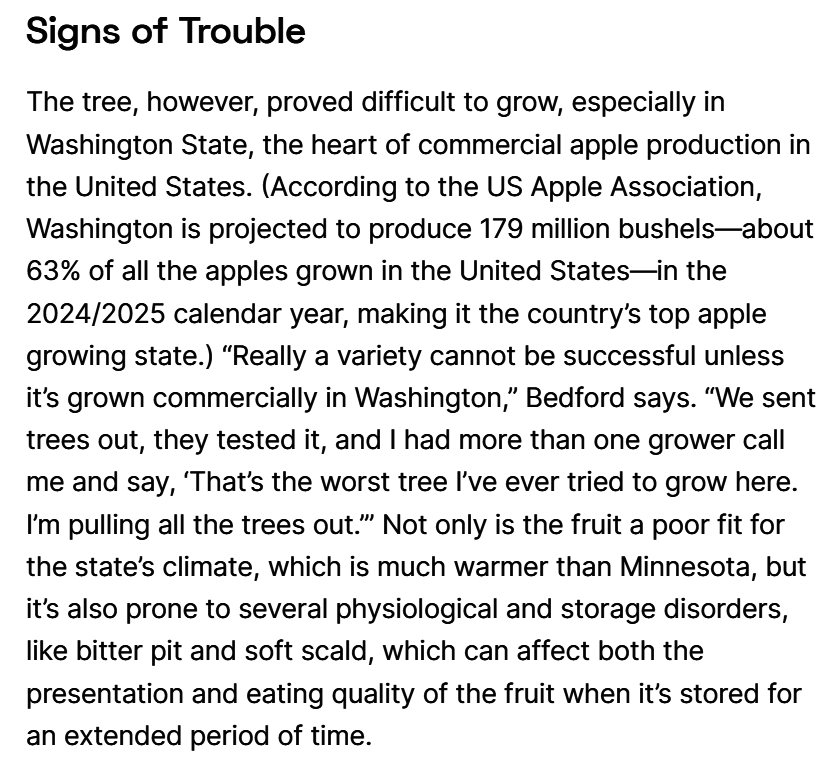
“Really a variety cannot be successful unless it’s grown commercially in Washington,” Bedford says. “We sent trees out, they tested it, and I had more than one grower call me and say, ‘That’s the worst tree I’ve ever tried to grow here. I’m pulling all the trees out.’” Not only is the fruit a poor fit for the state’s climate, which is much warmer than Minnesota, but it’s also prone to several physiological and storage disorders, like bitter pit and soft scald, which can affect both the presentation and eating quality of the fruit when it’s stored for an extended period of time.
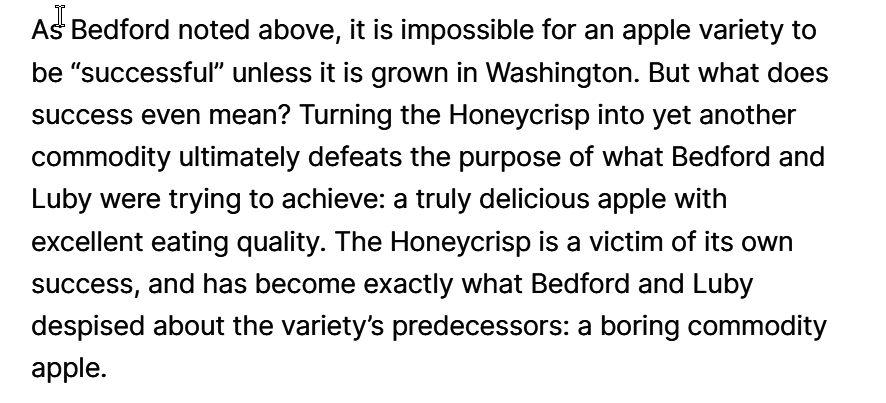
As Bedford noted above, it is impossible for an apple variety to be “successful” unless it is grown in Washington. But what does success even mean? Turning the Honeycrisp into yet another commodity ultimately defeats the purpose of what Bedford and Luby were trying to achieve: a truly delicious apple with excellent eating quality. The Honeycrisp is a victim of its own success, and has become exactly what Bedford and Luby despised about the variety’s predecessors: a boring commodity apple.
meta: here’s the same two paras from the article; these will survive web rot, but are not searchable. the text above is searchable but not “real”?